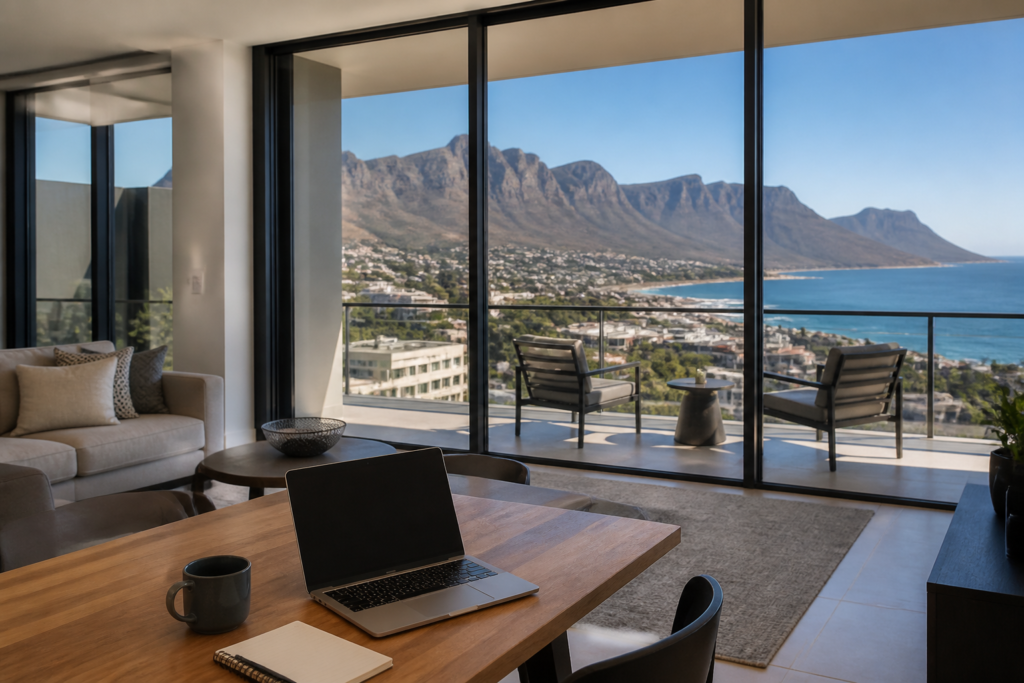
For the modern contractor, property developer, or building professional, the “workation” — a hybrid of remote work and leisure — is no longer a luxury but a operational necessity. In the South African context, however, selecting a property that can actually support professional-grade productivity requires more than just a cursory glance at interior aesthetics. It requires an assessment of building infrastructure, energy resilience, and digital connectivity. In the Western Cape, where the property market is dense and varied, identifying Cape Town city holiday rentals that meet these technical specifications is the difference between a seamless project handover and a logistical failure.
Energy Resilience and Load-Shedding Mitigation
The primary concern for any professional working from a residential unit in South Africa remains the stability of the power supply. When evaluating holiday accommodation, one must look beyond the furniture and interrogate the building’s electrical backup systems. A standard “load-shedding friendly” claim often only covers emergency lighting or a small UPS for the router.
For a high-functioning workation, the property should ideally feature a grid-tied inverter system with a lithium-ion battery bank capable of sustaining a 3kW to 5kW load for at least four hours. Professionals in the construction and design sectors, who often run power-hungry CAD software or high-resolution rendering tools, cannot rely on basic lead-acid batteries which suffer from rapid depth-of-discharge degradation. Leading agencies like Cape Town Holiday Apartments have increasingly prioritised listings in buildings that feature integrated PV (photovoltaic) arrays or centralised generator sets that trigger automatically upon a grid outage, ensuring zero-latency transitions for remote servers.
Digital Infrastructure and Connectivity Standards
While most rentals offer “Free Wi-Fi,” the technical reality is often a shared ADSL or low-tier LTE connection that fails during peak usage or inclement weather. For a seamless workation, the requirement is Fibre-to-the-Home (FTTH) with a minimum synchronous speed of 50Mbps. This is critical for synchronising large site drawings, high-definition video conferencing, and cloud-based project management software.
Technical evaluators should inquire about the router’s placement and the presence of Cat6 Ethernet ports if high-speed stability is required. In many high-density developments, signal interference on the 2.4GHz band is high; therefore, access to a 5GHz band is a prerequisite. When selecting holiday accommodation in Cape Town, checking for the presence of mesh networking in larger multi-room apartments is advisable to prevent “dead zones” caused by the reinforced concrete internal walls common in South African high-rise construction.
Spatial Planning and Ergonomic Fit-outs
From a building management and interior specification perspective, the “work” component of a workation requires a dedicated zone that adheres to basic ergonomic principles. A kitchen island or a low coffee table does not suffice for 8-hour workdays. The ideal unit features a dedicated study or a workspace that is physically separated from the living and sleeping areas to maintain acoustic privacy during site calls.
Key features to look for include:
- Acoustic Insulation: Properties with double-glazing or high-STC (Sound Transmission Class) rated windows, particularly in the CBD or near major arterials like the N1 and N2.
- Lighting Design: Task lighting that provides a minimum of 500 lux at the desk surface, supplemented by natural light to reduce ocular strain.
- Climate Control: Compliance with SANS 10400-XA energy efficiency standards, including effective thermal insulation and high-efficiency HVAC systems to manage Cape Town’s seasonal temperature fluctuations.
Security and Site Logistics
For tradespeople and contractors, security extends beyond personal safety to include the protection of vehicles and specialized equipment. In the South African context, “secure parking” must be interrogated. Is it basement parking with 24-hour manned security and CCTV, or is it merely off-street? For those managing Cape Town-based projects while staying in Cape Town city holiday rentals, proximity to arterial roads and the availability of biometric access control for visitors or colleagues is a significant operational advantage.
Buildings that adhere to modern fire safety regulations, including clear egress paths and regularly serviced suppression systems, reflect a higher standard of overall building management, which usually correlates with better maintenance of the internet and power infrastructure. Specialists like Cape Town Holiday Apartments serve as an essential filter in this regard, vetting properties for these structural and operational benchmarks before they are offered to the professional market.
Conclusion
Selecting the right accommodation for a workation in Cape Town is an exercise in infrastructure auditing. By focusing on energy resilience, high-tier digital connectivity, and ergonomic spatial planning, professionals can ensure their remote office is as robust as their physical job site. In an industry where “time is money,” the technical specs of your rental are just as important as the views of Table Mountain.