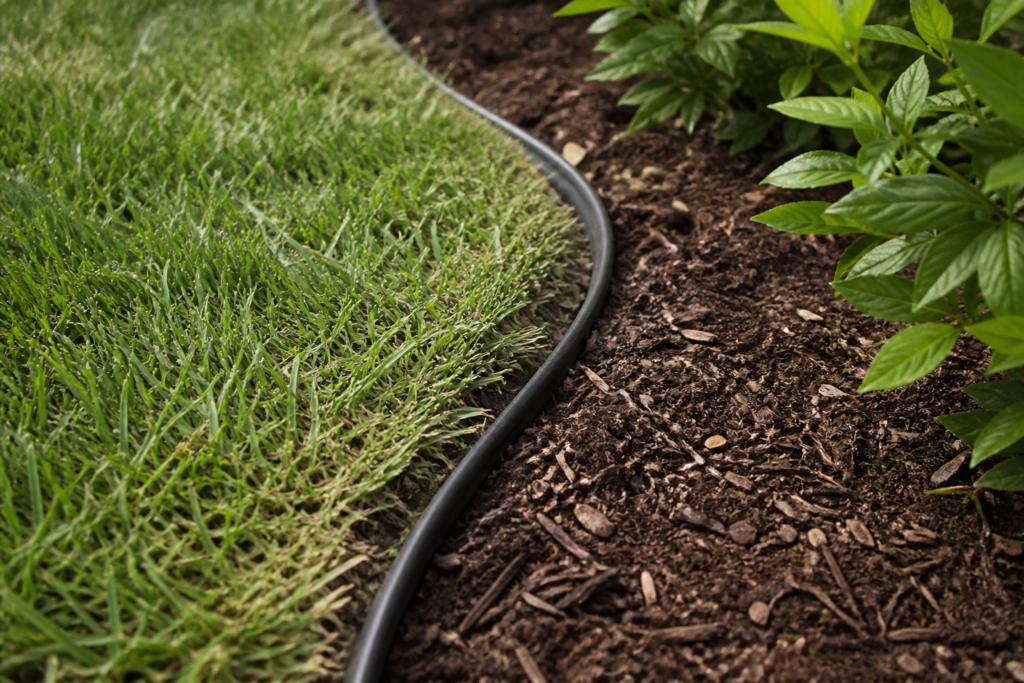
In the Johannesburg residential and commercial landscape sector, Kikuyu grass (Pennisetum clandestinum) remains the primary choice for lawns due to its resilience, rapid recovery, and tolerance for Highveld frost. However, for contractors and property managers, the very characteristics that make Kikuyu a robust turf—its aggressive growth via stolons and deep-reaching rhizomes—present a significant maintenance challenge. Without a structural subterranean barrier, Kikuyu inevitably breaches flowerbeds, undermines paved walkways, and disrupts irrigation systems. Mastering garden separation is not merely an aesthetic choice; it is a technical necessity for modern site management.
The Biological Challenge: Why Surface Barriers Fail
Most entry-level edging solutions, such as thin plastic strips or shallow timber slats, fail within the first two seasons of Johannesburg’s summer rainfall. Kikuyu grass is a rhizomatous species, meaning it spreads through underground stems that can penetrate depths of up to 200mm depending on soil compaction and moisture levels. When a barrier is too shallow, these rhizomes simply dive under the edging and emerge in the nutrient-rich soil of a cultivated garden bed.
Furthermore, the high UV index in Gauteng causes lower-grade plastics to become brittle and crack, creating gaps that the grass quickly exploits. For a permanent solution, professionals must look toward high-mass, deep-set barriers. This is where Professional Garden Edging in Johannesburg becomes an essential specification for any serious landscaping project, providing the physical density required to deflect aggressive root systems.
Technical Specifications of Pre-Cast Cobble Edging
The transition from a standard garden to a professionally managed landscape often hinges on the materials used for demarcation. Pre-cast concrete cobbles offer a significant advantage over poured-in-place or flexible edging. Their mass provides stability against the “heaving” common in Johannesburg’s clay-heavy soils during the wet season.
- Density and Durability: Pre-cast concrete blocks are manufactured to withstand mechanical damage from lawnmowers and edge trimmers.
- Sub-Surface Depth: Effective containment requires the edging to be set into a trench, often with a cement-stabilized base, to ensure that at least 100mm to 150mm of the barrier exists below the surface.
- Aesthetic Flexibility: While the primary function is containment, the visual “frame” provided by cobbles enhances property value and clarifies site lines for maintenance crews.
Working with a specialist like Garden Cobble Edging ensures that the installation meets these technical requirements. Their approach to high-quality edging solutions focuses on creating a “mowing strip”—a flat surface that allows lawnmower wheels to pass over the edge, eliminating the need for manual weeding or chemical sprays to control encroachment.
Installation Standards for Long-Term Stability
For contractors, the installation process is where the longevity of the boundary is determined. A “dry-laid” cobble will eventually shift as the soil settles or as roots exert pressure. To prevent this, a professional installation involves several key steps:
1. Trenching and Site Preparation
A consistent trench depth is vital. In Johannesburg, where soil can vary from sandy loam to stubborn shale, ensuring a level sub-grade is the first step in preventing the edging from “snaking” over time. The trench should be wide enough to accommodate the cobble and a supportive mortar bed.
2. The Mortar Bed and Haunching
To resist the lateral pressure of Kikuyu rhizomes and the weight of garden machinery, cobbles should be bedded into a semi-dry mortar mix. “Haunching”—the practice of sloping mortar up the back of the cobble on the garden side—provides additional structural support and ensures the blocks remain perfectly aligned despite ground movement.
3. Grouting and Finishing
Seamless joints are the final defense. By using a specialist contractor, property owners benefit from expert installers who understand how to grout the gaps between cobbles, preventing even the smallest stolon from finding a foothold between the blocks.
ROI and Maintenance Reduction
From a property management perspective, the initial capital expenditure of professional garden edging is rapidly offset by the reduction in labor costs. Manual “spade edging” is a common practice in South Africa, but it is fundamentally destructive. Every time a laborer cuts a new edge with a spade, they remove soil and deepen a trench that eventually leads to erosion and “collapsed” lawn edges.
By installing a permanent, concrete-based edging system, the site maintenance plan shifts from “repair and contain” to “mow and go.” This not only preserves the architectural integrity of the garden design but also ensures that irrigation spray patterns remain consistent, as the lawn line never moves.
In conclusion, while Johannesburg’s climate provides the perfect environment for lush lawns, it demands a disciplined approach to garden boundaries. Utilizing professional-grade pre-cast cobble edging is the only proven method to stop Kikuyu grass from claiming territory where it isn’t wanted, ensuring a clean, low-maintenance finish for years to come.