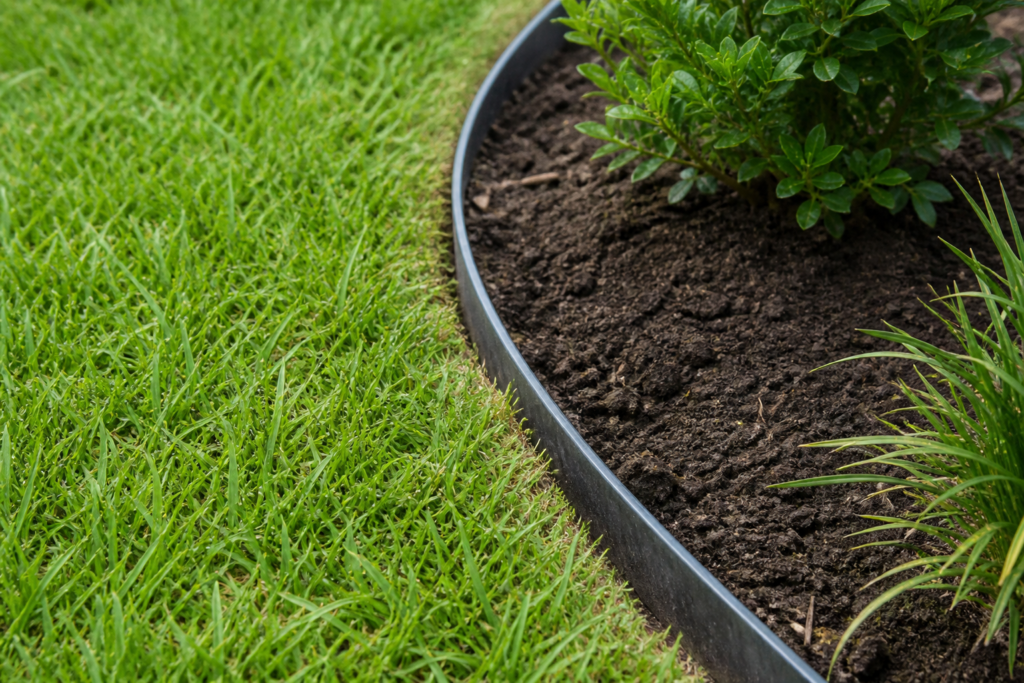
In the Johannesburg landscape, few elements are as persistent or as potentially damaging to hardscaping as Kikuyu grass (Pennisetum clandestinum). While its drought tolerance and rapid recovery make it a staple for Highveld lawns, these same traits present a significant engineering challenge for contractors and property owners. The aggressive growth habit of Kikuyu, which utilizes both surface stolons and deep-running underground rhizomes, allows it to bypass superficial borders, infiltrating paving joints and destabilizing garden beds. For the professional builder or landscaper, the primary objective is creating a permanent, impenetrable barrier that maintains site integrity without constant manual intervention.
The core of the issue lies in the biology of the grass itself. In Johannesburg’s climate, Kikuyu can grow up to 25mm per day during the peak summer months. Traditional edging solutions—such as thin plastic strips, loosely laid bricks, or timber—frequently fail because they do not provide sufficient depth or structural density to halt rhizome expansion. To achieve true garden separation, a transition to durable garden edging is required, moving away from decorative trim toward functional civil engineering for the residential and commercial landscape.
The Technical Requirements of Garden Separation
Effective garden separation in the South African context requires more than just a visual boundary; it requires a physical “curb” that addresses two specific vectors of growth. First, the barrier must be high enough to prevent stolons from “leaping” over the edge into flower beds or over paving. Second, and more importantly, the barrier must extend deep enough into the soil profile to intercept rhizomes, which typically travel in the upper 100mm to 150mm of the soil.
Specialist contractors, such as Garden Cobble Edging, advocate for a cast-concrete or heavy-duty masonry approach. By utilizing professional garden edging in Johannesburg, property owners can ensure that the installation is bedded into a trench that effectively severs the path of least resistance for grass roots. A professional installation involves several critical steps:
- Site Survey and Trenching: Identifying the exact “line of defense” and excavating to a depth that allows for a stable foundation and a submerged barrier.
- Material Density: Using high-strength concrete or cobble mixes that resist the hydrostatic pressure of soil and the mechanical force of aggressive root systems.
- Continuous Alignment: Ensuring no gaps exist between segments. Infiltrating grass only needs a 2mm gap to breach a perimeter.
Why Modular Cobble Beats In-Situ Pouring for Residential Sites
While large-scale civil projects might use continuous concrete extrusions, modular cobble edging offers distinct advantages for Johannesburg’s residential and retail sectors. Soil movement, often caused by the city’s seasonal moisture fluctuations and clay-heavy pockets, can cause monolithic concrete strips to crack. Modular systems, when installed with the correct mortar mix and technical oversight, provide the necessary flexibility to withstand ground heave while maintaining a solid barrier. This engineered garden separation ensures that the aesthetic appeal remains intact even as the structure performs its heavy-duty task.
Integration with Hardscaping and Site Security
From a construction management perspective, garden edging is often the final piece of the puzzle that protects the initial investment in hardscaping. When Kikuyu grass infiltrates paving, it lifts the pavers, compromises the bedding sand, and leads to water ingress during Johannesburg’s intense summer thunderstorms. This can result in costly repairs and structural failure of walkways or driveways.
By integrating Garden Cobble Edging solutions early in the finishing phase of a project, contractors can provide a handover that is significantly lower in maintenance. The presence of a substantial concrete barrier also allows for more efficient mechanical trimming. Edging tools and lawnmowers can run directly against the hardened surface without risk of damaging the grass or the border, providing a crisp, professional finish that lasts for years.
NHBRC Standards and Property Value
While garden edging may seem like a secondary concern compared to the primary structure, the NHBRC and modern building standards emphasize the importance of site drainage and the stability of the immediate surrounding soil. Poorly managed vegetation can lead to damp issues and soil erosion near foundations. A robust, professionally installed edging system directs water runoff more effectively and prevents the “creeping” of organic material into areas designed for drainage.
In conclusion, mastering garden separation in the Highveld requires a move away from DIY methods toward industrial-strength solutions. By employing the specialized techniques and materials provided by industry experts, property owners and developers can ensure that their landscapes remain as pristine as the day they were completed, effectively holding the line against the relentless spread of Kikuyu grass.